Stake Poker HUD Stats Explained: How to Read Every BearHUD Number
If you play online poker on Stake with BearHUD open, you have a wall of numbers next to every opponent's name. Most players glance at VPIP and PFR, then ignore the rest. That is a mistake. The full HUD panel tells a story about how someone plays, and each stat points to a specific exploit. This guide breaks down the BearHUD stats that matter most, what they mean, and how to turn them into better decisions at Stake poker tables.
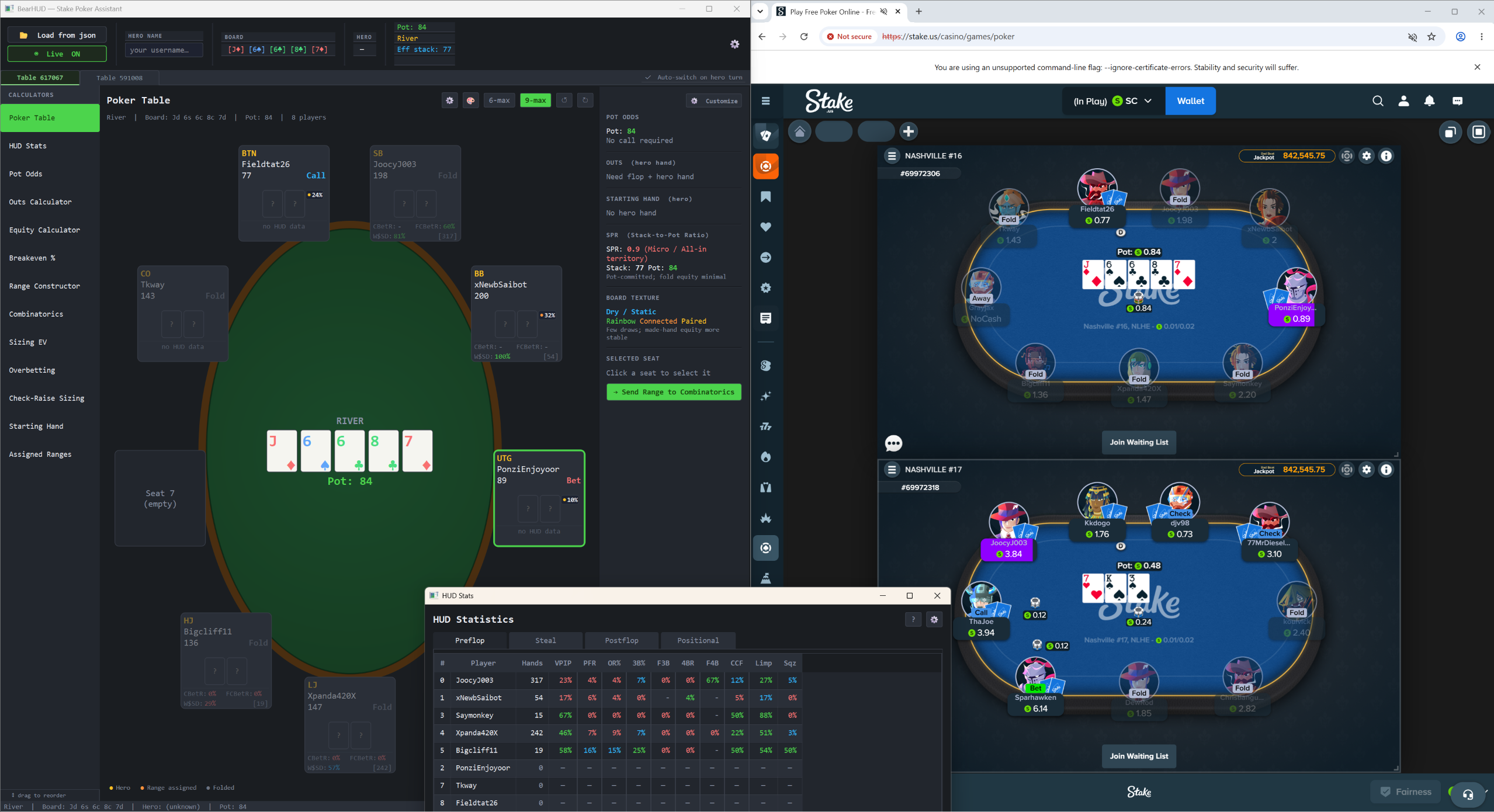
Preflop: figuring out their range
VPIP, which means how often a player voluntarily enters the pot, and PFR, which means how often they raise preflop, are the foundation of every poker HUD read. The most important detail is not just each number by itself. It is the gap between them.
- •High VPIP and low PFR: this is a loose-passive player. They call a lot but rarely raise. Isolate them with raises, value bet thinner, and do not spend much energy bluffing because they are not looking for reasons to fold.
- •VPIP close to PFR: this player raises most hands they choose to play. They are more aggressive, harder to push around, and their raises deserve more respect than a loose-passive player's calls.
- •Both VPIP and PFR are low: this is a nit or very tight player. They are mostly waiting for premiums, so give their big preflop aggression credit until they prove otherwise.
BearHUD shows these numbers because they are the fastest way to categorize a player on Stake. A 45/8 opponent and a 24/21 opponent might both enter pots, but they are making completely different mistakes.
3Bet% and F3B
3Bet% and F3B, or fold to 3-bet, belong together. A high 3-bet stat with a high fold-to-3-bet stat often points to someone who attacks wide but does not enjoy being attacked back. That can be a green light to 3-bet bluff, 4-bet light with blockers, or widen your continuing range in position.
Low 3Bet% and low F3B is a very different profile. Their reraises are usually value-heavy, and they are not putting money in preflop just to fold. Against that player type, do not turn a marginal hand into a guessing game.
4Bet%
4Bet% is usually one of the strongest preflop signals in the HUD. In many pools, especially at lower stakes, a 4-bet still means a condensed value range like QQ+, AK, or close to it. If a player has a low sample and suddenly 4-bets, be careful about assuming they are balanced.
SQZ%, Limp%, and CC%
SQZ% measures how often a player squeezes after a raise and at least one call. A high squeeze stat usually marks an aggressive, exploitative player who sees dead money and attacks it. You can respond by 4-betting more selectively, trapping stronger hands, or avoiding loose cold calls that invite squeezes.
Limp% and CC%, or cold-call percentage, flag passive players who enter pots without initiative. Iso-raise limpers relentlessly when stacks and position allow it. You will often win the pot immediately, and when called you usually play against a weaker range with initiative.
Steal and fold-to-steal stats
Steal stats such as StlBTN, StlCO, and StlSB show how often a player attacks the blinds from late position. Fold-to-steal stats such as FStlBB and FStlSB show how often the blinds give up. These are a matched pair.
- •High steal percentage: widen your blind defense, especially against button and small blind steals.
- •High fold-to-steal percentage: steal their blinds constantly until they adjust.
- •Low fold-to-steal percentage: value raise more and reduce low-equity steals that play badly after a call.
Postflop: where the money actually moves
Preflop stats tell you what range a player starts with. Postflop stats tell you how they use it. This is where the biggest exploits show up, because many players have obvious patterns after the flop.
C-bet frequency by street
CBetF, CBetT, and CBetR show how often a player continuation-bets the flop, turn, and river after taking the lead. A player who c-bets the flop heavily but rarely barrels the turn is a classic one-and-done bettor. Call the flop with hands that can continue, then attack when they check the turn.
A player who barrels flop, turn, and river at high frequency applies real pressure. Against them, you need stronger bluff-catchers, better blockers, and a plan before you call the first bet.
Fold-to-c-bet by street
FCBetF, FCBetT, and FCBetR are the mirror image. A high fold-to-flop-c-bet stat means you can bet many flops against them, especially boards that favor your range. If they call the flop but fold the turn too often, they are calling once to see what happens and then giving up. You usually do not need a fancy three-barrel line to beat that profile.
XRF, XRT, DonkF, and ProbeT/R
XRF and XRT show check-raise frequency on the flop and turn. A high check-raise stat means you should think twice before thin value betting vulnerable hands. They are capable of putting you in tough spots.
DonkF tracks flop donk bets, while ProbeT and ProbeR track bets after the previous street checked through. These bets often come from less experienced or opportunistic players. At lower stakes, many probe and donk bets are range-capped or protection-heavy, which means they can often be raised when board texture and blockers cooperate.
Showdown stats: the fastest read in the panel
If you only have time to check three BearHUD numbers after the flop, make them WTSD, W$SD, and AFq. Together, they tell you whether someone calls too much, wins at showdown, and applies pressure often.
- •WTSD, or went to showdown after seeing a flop: high means they call down too often, so value bet more and bluff less. Low means they fold before showdown often, so bluff them more in credible spots.
- •W$SD, or won money at showdown: low W$SD plus high WTSD is the calling-station signature. Value bet relentlessly and stop trying to push them off hands.
- •AFq, or aggression frequency: this is often more reliable than raw aggression factor because it measures aggressive actions against total postflop actions. High AFq means they apply pressure often. Low AFq means their aggression is usually more meaningful.
AF, AFF, AFT, and AFR break aggression down overall and by street. A player who is passive on the flop but suddenly aggressive on the river may be slowplaying or value-heavy. Do not use one overall aggression number when the street-by-street pattern is telling you something sharper.
WWSF
WWSF means won when saw flop. It captures pots won by forcing folds, not just pots won at showdown. A high WWSF player is winning more than their fair share after seeing flops, often through pressure. A low WWSF player may be too passive, too fit-or-fold, or simply losing too many postflop battles.
Turning BearHUD stats into exploits
The point of a Stake poker HUD is not to memorize numbers. It is to identify the mistake an opponent repeats and choose the exploit that punishes it.
- •Loose-passive profile: high VPIP, low PFR, high WTSD. Isolate preflop, value bet thin, bluff less.
- •Nit profile: low VPIP, low PFR, low aggression until they wake up. Steal often, but fold more when they show real strength.
- •One-and-done profile: high flop c-bet, low turn c-bet. Float more flops and attack turn checks.
- •Fit-or-fold profile: high fold-to-c-bet and low WWSF. C-bet more often and apply pressure on good boards.
- •Pressure profile: high AFq, high WWSF, high steal or squeeze stats. Trap more value, defend with better blockers, and avoid overfolding automatically.
- •Calling-station profile: high WTSD and low W$SD. Bet for value, use bigger sizing when they are inelastic, and cut most river bluffs.
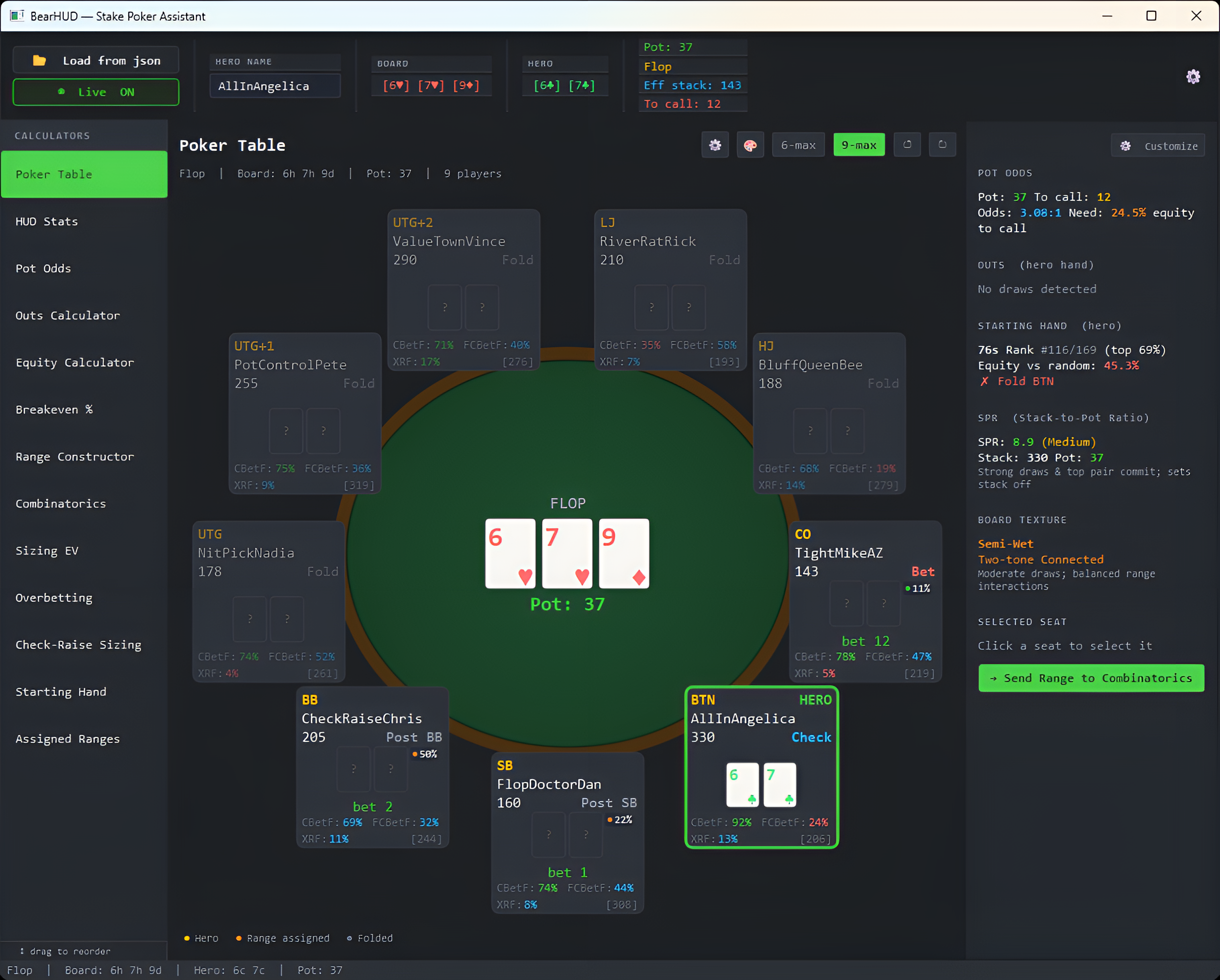
The catch: sample size matters
None of this works perfectly on small samples. Treat anything under a couple hundred hands as a hypothesis, not a fact. VPIP and PFR stabilize faster than rare stats like 4Bet%, check-raise, or river aggression. If someone has only had two chances to fold to a c-bet, a 100% fold-to-c-bet number is interesting, not conclusive.
Good players also know their stats create an image. They may deliberately play against what their HUD profile suggests. Use BearHUD to form a read, then confirm it with the actual hands and lines you see at the table.
Why this matters on Stake
Stake poker games can move quickly, especially when multi-tabling. Without a HUD, you are relying on memory. With BearHUD, the most important tendencies are visible next to the table: who calls too much, who folds too much, who attacks blinds, who barrels, and who only wakes up with value.
Bring live HUD stats, pot odds, outs, ranges, and table context to your Stake sessions. Try BearHUD free for 7 days.
Start Free TrialAbout the author
The BearHUD Team
BearHUD is a Stake-native poker HUD and calculator suite built by a small team of online poker players and engineers. We've shipped a HUD used by 350+ players on Stake.com and Stake.us, and we write these guides from hands-on experience analyzing real play at the tables.