The Rule of 2 and 4: How to Estimate Poker Equity From Outs
The Rule of 2 and 4 is the fastest way to estimate your equity when you're drawing. After building BearHUD's outs calculator, we see the same pattern over and over: players know they have a flush draw or straight draw, but they don't always know whether the price they're getting is actually good. Counting outs turns that guess into a number. The Rule of 2 and 4 turns that number into an equity estimate you can use at the table in seconds.
What are outs?
Outs are the unseen cards that improve your hand to what you believe will be the winner. If you have four cards to a flush on the flop, there are usually 9 cards left in that suit, so you have 9 flush outs. If you have an open-ended straight draw, there are usually 8 cards that complete the straight. If you have a gutshot, there are usually 4.
The important word is usually. Not every card that improves your hand is a clean out. Sometimes an out gives you a strong hand but gives your opponent an even stronger one. Those are dirty outs, and they need to be discounted.
The Rule of 2 and 4
On the turn, multiply your outs by 2. On the flop, multiply your outs by 4.
Use the Rule of 2 when there is one card to come. Use the Rule of 4 on the flop when you expect to see both the turn and river. The result is a quick estimate of your chance to hit by showdown.
- •9-out flush draw on the flop: 9 x 4 = about 36% equity
- •9-out flush draw on the turn: 9 x 2 = about 18% equity
- •8-out open-ended straight draw on the flop: 8 x 4 = about 32%
- •4-out gutshot on the flop: 4 x 4 = about 16%
This is close enough for most real-time decisions. If the pot odds require 25% equity and your draw has roughly 36%, calling is usually profitable. If the pot odds require 30% and your draw has roughly 16%, you need a very good reason to continue.
Why the shortcut works
The exact math is based on unseen cards. On the turn, you usually know 6 cards: your 2 hole cards and 4 board cards. That leaves 46 unseen cards. A 9-out flush draw is 9 / 46 = 19.6%. The Rule of 2 gives 18%, which is slightly low but easy to do instantly.
On the flop, you usually know 5 cards: your 2 hole cards and the 3-card flop. That leaves 47 unseen cards. With 9 outs, the exact chance to hit by the river is the chance you hit on the turn or river, which is about 35%. The Rule of 4 gives 36%. Again, close enough to make the table decision.
Common draw types and outs
- •Flush draw: usually 9 outs
- •Open-ended straight draw: usually 8 outs
- •Gutshot straight draw: usually 4 outs
- •Two overcards: up to 6 outs, but often not all clean
- •Flush draw plus straight draw: often 12-15+ outs after removing overlap
- •Pair plus draw: count the draw first, then decide whether pair/trips outs are clean
Combo draws are where players often make expensive mistakes. If a card completes both your flush and straight, it is still only one card. You do not get to count it twice. BearHUD's outs calculator de-duplicates shared out cards when combining selected draws, so the total reflects actual cards left in the deck rather than inflated categories.
Clean outs vs dirty outs
A clean out is a card that likely gives you the best hand. A dirty out improves you but may still lose. For example, if you have a straight draw on a two-tone board, one of your straight cards might also complete the flush. If your opponent can have that flush, that card is not worth a full out.
Overcard outs are another classic trap. If you have Ace-King on a low board, you might say you have 6 outs to top pair. But if villain already has two pair, a set, or a pair plus a better redraw, hitting one pair may not be enough. In spots like this, you should discount your overcard outs instead of blindly counting all 6.
- •Count full outs when the improved hand is very likely best
- •Discount outs that complete obvious flushes or straights for villain
- •Discount overcards against strong ranges or multiway pots
- •Be extra careful when the board is paired, because trips/full houses can kill apparent flush or straight outs
What are implied outs?
Implied outs are not literal cards that instantly complete your hand. They are a way to account for extra future value when a draw has hidden upside. The most common example is a backdoor draw: you need both the turn and river to help, so it is much weaker than a direct draw, but it still adds some equity and future playability.
In BearHUD's outs calculator, backdoor flush draws are shown as implied outs instead of direct outs. A backdoor flush usually needs two cards of the same suit to arrive. That is not a real 9-out flush draw, so the app treats it as a small fractional boost, roughly 1.5 implied outs, and labels it separately so you don't mistake it for a made direct draw.
This matters in close decisions. A naked gutshot with 4 outs is often too weak to call a large bet. But a gutshot plus a backdoor flush draw, two overcards, and position may be playable because your hand has more ways to improve and more ways to realize equity later.
Implied odds are different
Implied outs and implied odds are related, but they are not the same thing. Implied outs are extra equity-like credit for backdoor or future-improvement potential. Implied odds are the extra chips you expect to win after you hit. Small pocket pairs are the classic implied-odds hand: you miss most flops, but when you hit a set, you can win a big pot.
The mistake is using implied odds as an excuse to call anything. You need enough stack depth, an opponent who will pay you off, and a draw that is disguised enough to get action. A shallow stack, obvious draw, or opponent who folds too much reduces your implied odds dramatically.
A simple table workflow
- Identify your direct draw: flush draw, straight draw, overcards, or combo draw.
- Count only clean outs first.
- Use Rule of 4 on the flop or Rule of 2 on the turn.
- Compare that equity to the required equity from pot odds.
- Add context: position, stack depth, implied odds, fold equity, and opponent type.
This workflow keeps you from making the two biggest mistakes: folding profitable draws because the bet feels big, and calling bad draws because the hand feels close.
Doing it instantly with BearHUD
BearHUD's outs calculator detects flush draws, open-ended straight draws, gutshots, combo draws, backdoor flush draws, and overcards from the live table context. It shows exact next-card and by-river probabilities, then also displays the Rule of 2 and Rule of 4 estimate so you can sanity-check the shortcut.
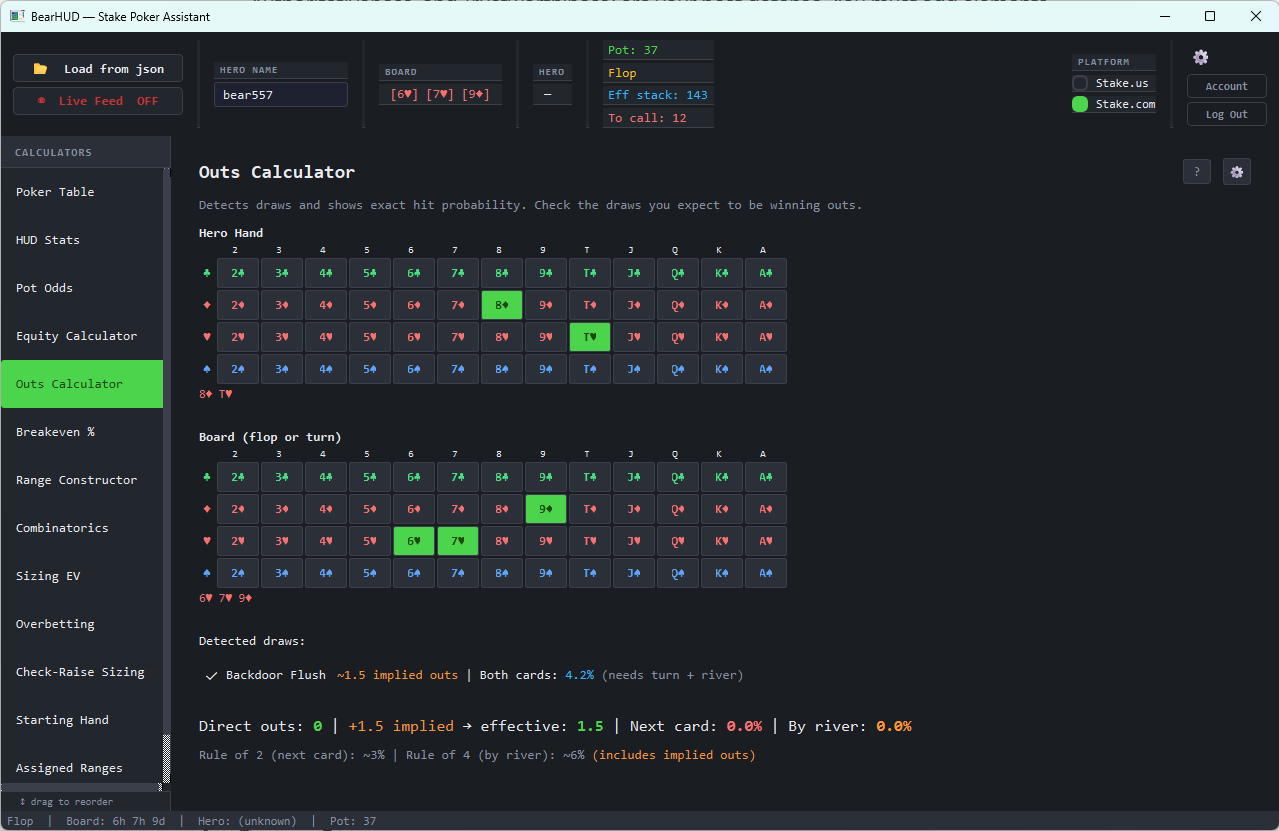
The calculator also lets you check or uncheck draw types based on whether you believe they are clean. That matters because poker equity is not just math in a vacuum. Your opponent's range, the board texture, and whether your outs are clean all decide whether a call is actually profitable.
Count outs, see exact draw equity, and compare it to the price you're getting. Try BearHUD free for 7 days on Stake.
Start Free TrialAbout the author
The BearHUD Team
BearHUD is a Stake-native poker HUD and calculator suite built by a small team of online poker players and engineers. We've shipped a HUD used by 350+ players on Stake.com and Stake.us, and we write these guides from hands-on experience analyzing real play at the tables.