How to Calculate Pot Odds in Poker (With Examples)
Pot odds are the single most important piece of math in poker, and after building a pot odds calculator used at real Stake tables every day, we've seen exactly where players get them wrong. Pot odds tell you, in one number, whether calling a bet is profitable in the long run. Master them and you stop guessing on every call and start making decisions you can actually defend. This guide walks through the formula, the quick mental shortcut, and worked examples you can apply at the table today.
What are pot odds?
Pot odds are the ratio between the size of the current pot and the cost of a call you're facing. They answer a simple question: how often does your hand need to win for this call to break even? If you have to put in a small amount to win a large pot, you don't need to win very often to profit.
The key insight is that you compare your pot odds to your equity (your chance of winning the hand). If your equity is higher than the percentage the pot odds demand, calling is profitable. If it's lower, folding is correct.
The pot odds formula
To turn pot odds into the equity you need, use this formula:
Required equity = call amount / (pot after your call)
In other words, take the amount you have to call, and divide it by the total pot that would exist after you call (the current pot plus the bet plus your call). That gives you the minimum win percentage you need to break even.
Worked example
Suppose the pot is $100 and your opponent bets $50. You have to call $50 to continue.
- The pot before your call is $100 + $50 = $150.
- After you call $50, the total pot is $200.
- Required equity = $50 / $200 = 0.25, or 25%.
So you need to win at least 25% of the time for this call to break even. If you're on a flush draw with roughly 36% equity, calling is clearly profitable. If you only have an overcard with 15% equity, you should fold.
The quick shortcut: bet relative to the pot
You don't always have time for division at the table. A faster way is to memorize the required equity for common bet sizes relative to the pot:
- •Half-pot bet: you need about 25% equity to call
- •Two-thirds-pot bet: you need about 29% equity
- •Full-pot bet: you need about 33% equity
- •Double-pot overbet: you need about 40% equity
Notice that even a full-pot bet only requires you to win one time in three. In our experience watching real play, folding too often to big bets is one of the most common and costly leaks players have.
Pot odds vs your outs
On the flop or turn, your equity usually comes from drawing to a better hand. A quick way to estimate it is the Rule of 2 and 4: multiply your number of outs by 2 on the turn, or by 4 on the flop (when you'll see both remaining cards), to approximate your win percentage. Compare that estimate to the equity your pot odds require, and you have your answer.
For example, a flush draw has 9 outs. On the flop, 9 x 4 = 36% equity. Against the 25% required by a half-pot bet, that's an easy call.
Doing it instantly at the table
The math is simple in theory, but doing it accurately every hand, while also estimating your opponent's range, is where players slip. That's exactly what a calculator at the table is for. BearHUD's pot odds tool reads the live pot and bet on your Stake table and gives you a clear CALL or FOLD verdict with the exact equity you need, and its outs and equity calculators handle the harder cases automatically.
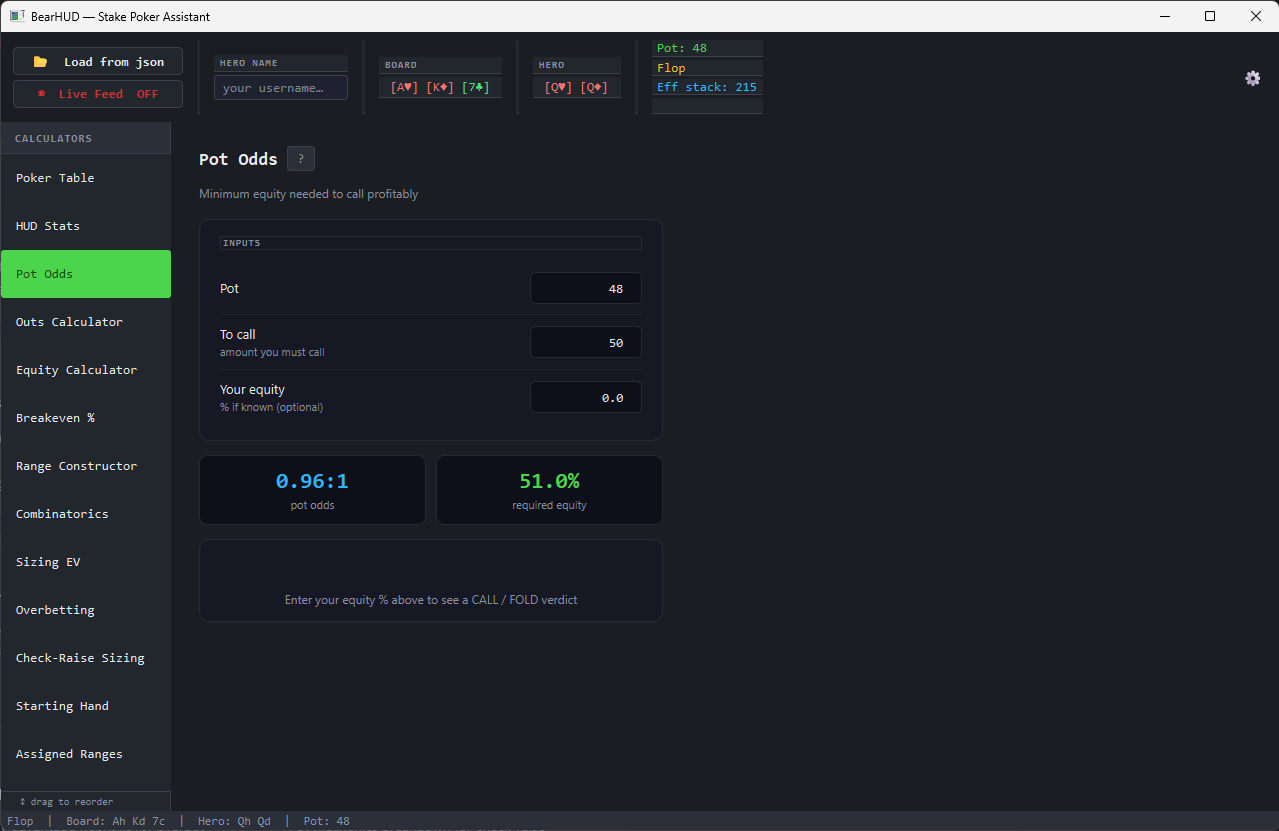
Stop guessing on close calls. Try BearHUD free for 7 days and get instant pot odds at your Stake tables.
Start Free TrialAbout the author
The BearHUD Team
BearHUD is a Stake-native poker HUD and calculator suite built by a small team of online poker players and engineers. We've shipped a HUD used by 350+ players on Stake.com and Stake.us, and we write these guides from hands-on experience analyzing real play at the tables.